A desert residence designed for a creative neurodivergent client with adult children and grandchildren. The home supports a work-from-home lifestyle, incorporating both dedicated office space and a flexible workshop. The design emphasizes intuitive spatial navigation, a strong connection to the outdoors, and adaptability for future resale.
Outdoor living is integral, with provisions for food cultivation and rainwater harvesting, reflecting the client’s interest in gardening and self-sufficiency.
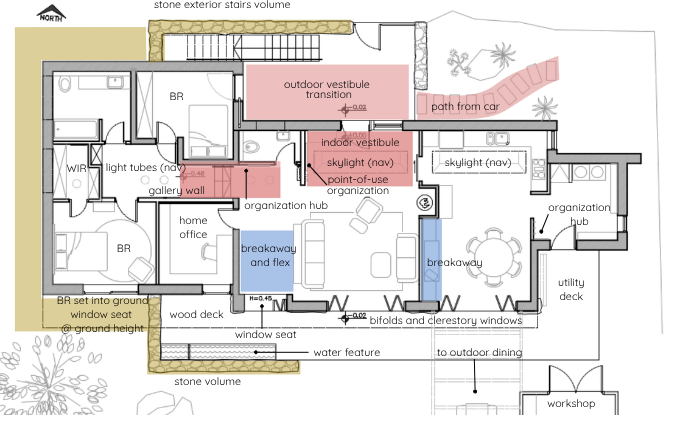
Public and private zones are clearly defined, with opportunities in larger zones for secondary breakaway space as sensory balance zones or as transition zones to different activities.
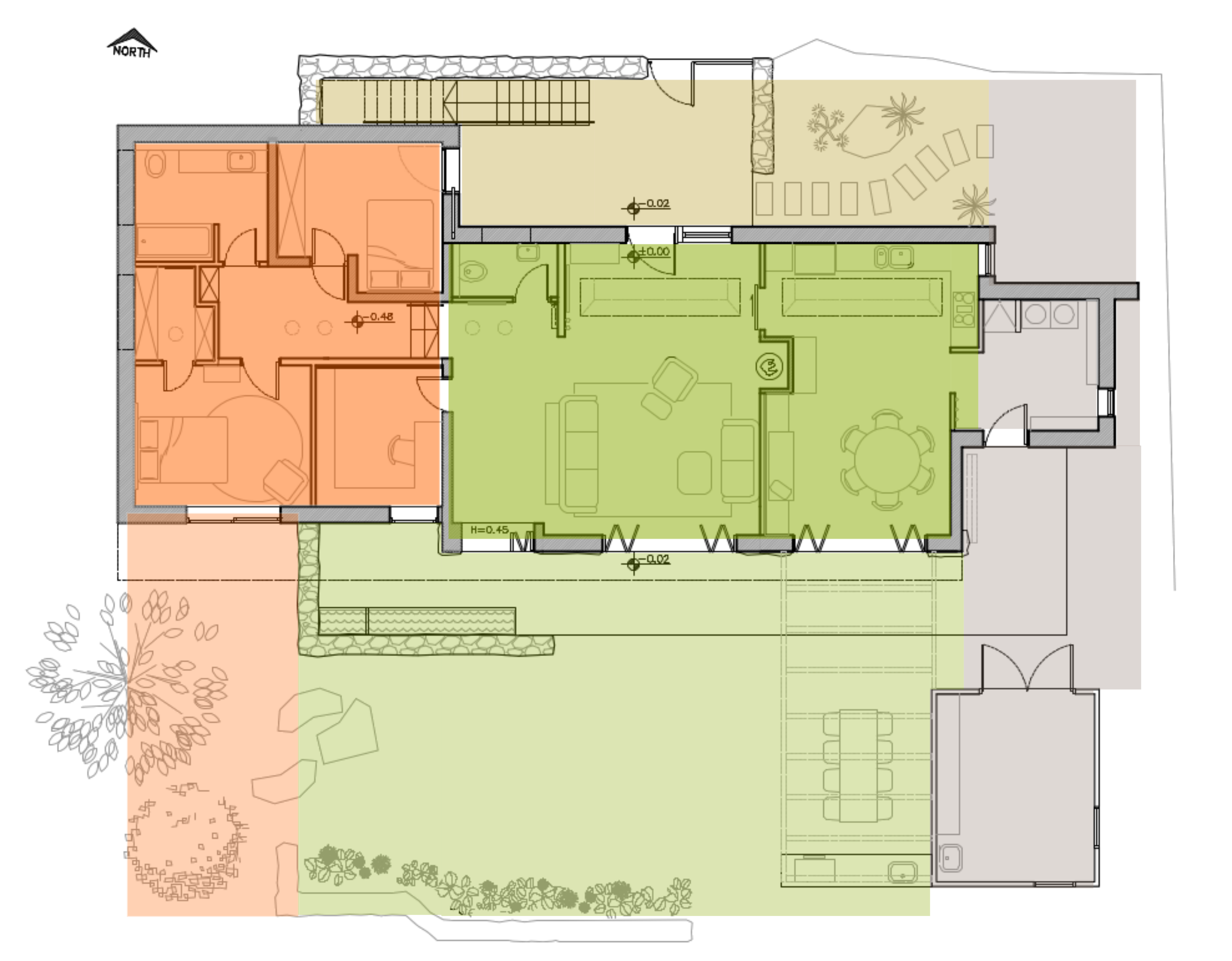
Indoor spaces include two bedrooms, a home office, a central living space, family bath powder room, and a pantry-laundry. The kitchen and dining area are conceived as a distinct, self-contained space with a unique atmosphere, while allowing future owners the option to open it up to the living area.
Outdoor zones are integrated as extensions of the interior living spaces, each defined by a distinct program that addresses both functional needs and sensory experience.
FOCUS
Design as Navigation
Sensory Declutter
Executive Function
Connection and Grounding
Breakaway and Transition
Biophilia
A meandering path leads from the carport to the front entry vestibule, winding through a drought-tolerant landscape of pebbles and succulents. The outdoor vestibule, defined by a stone stair volume to the private roof deck, gently encloses the approach, creating a sense of arrival while providing a buffer both for privacy and to ease the transition from the outside world to the inner life of the home.
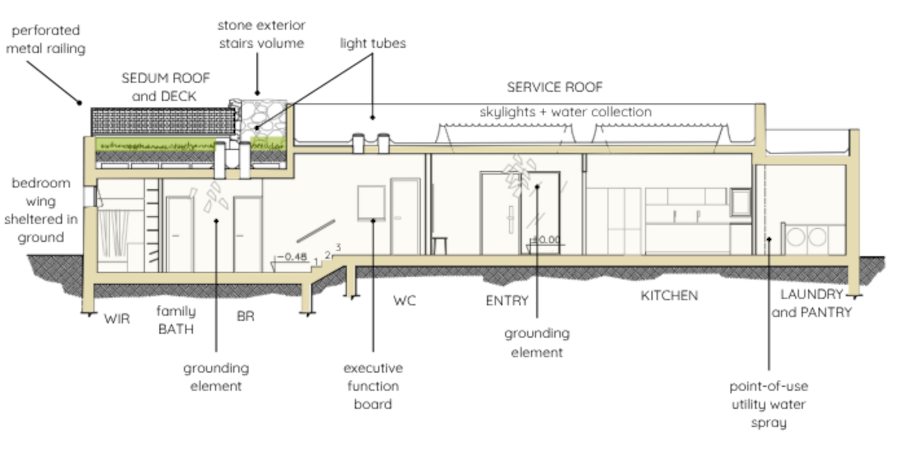
The indoor entry is anchored by a skylight that introduces natural light as a grounding element, while integrated storage supports the routines of arrival and departure.
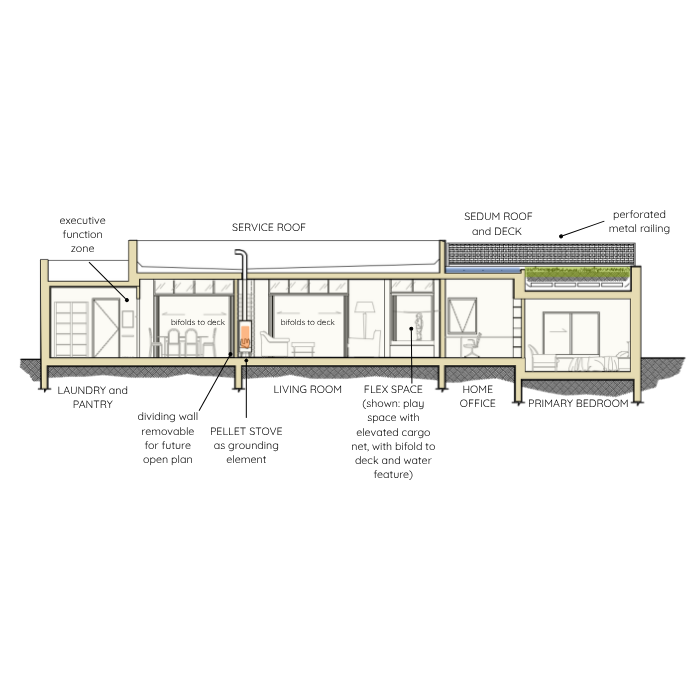
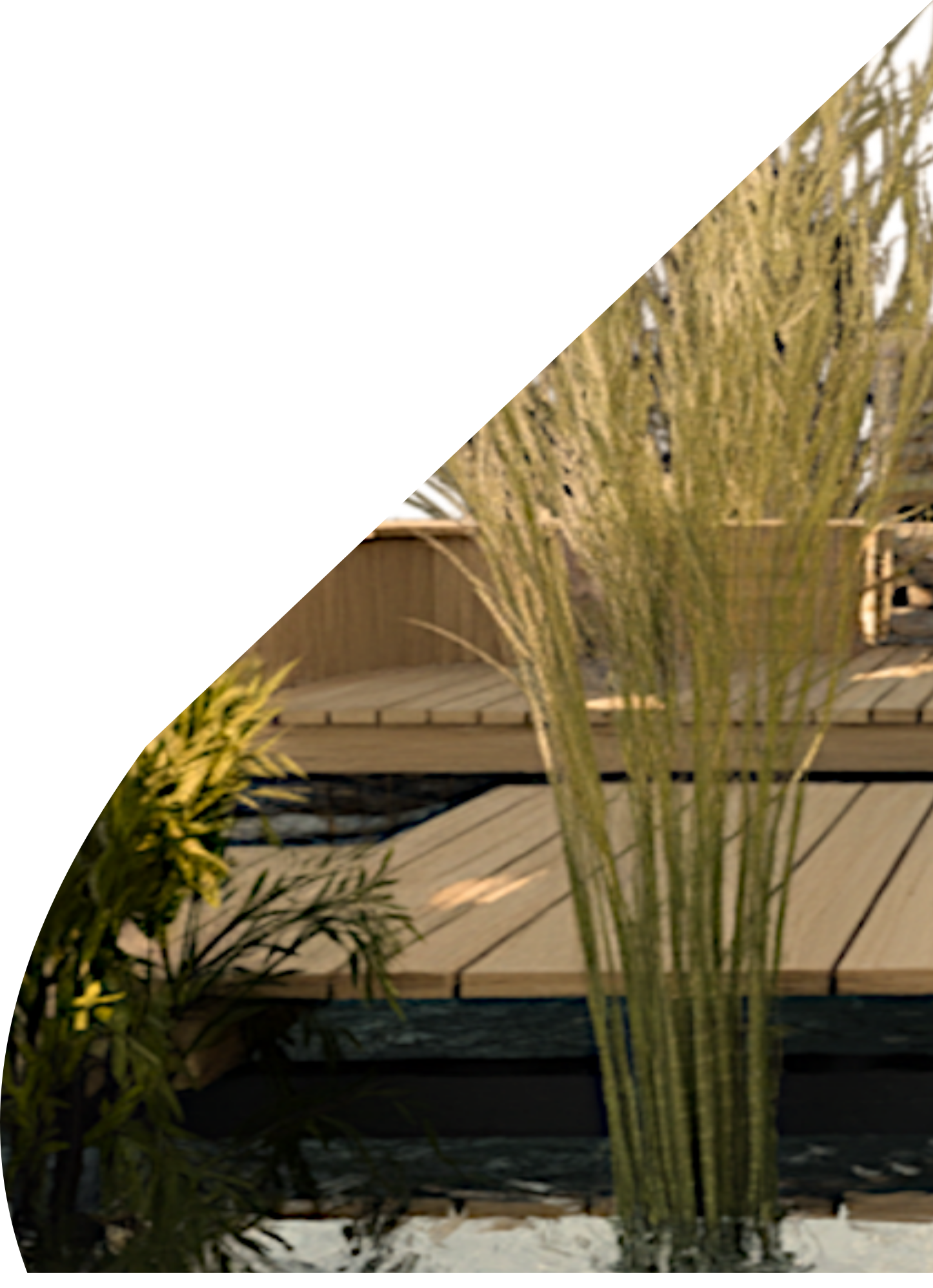
The central living space is organized to accommodate both social gathering and moments of retreat, with subtle zoning that allows for flexible, low-stimulation breakaway areas within a cohesive whole. Bifolds lead to a wood deck and interactive garden beyond.
At the heart of the home, a pellet stove serves as both a thermal anchor and spatial focal point. The kitchen and dining area are conceived as a task-specific open zone, set apart from the living space to support focused use while providing acoustic and olfactory separation.
A three-step descent marks the transition to the bedroom wing, subtly signaling a shift in use while creating a more enclosed, restful environment. Set approximately half a meter into the ground, the lowered level enhances the sense of being gently held and embraced.
Clerestory windows and slim skylights modulate daylight throughout the day, aligning the interior experience with the natural rhythm of the sun. Integrated zero-frame doors, a large-scale artwork concealing the sliding kitchen partition, and articulated ceiling elements further reinforce the character and function of each zone.
The home is designed to offer a high degree of control over the living environment: airflow, light, acoustics, and ceiling features are carefully modulated to shape the desired atmosphere, while flexible breakaway spaces support shifting needs, goals, and moods.
FLEXIBILITY
Although the design responds closely to the client’s long-term and unconventional requirements, it incorporates strategies for future adaptability and resale. These include a removable partition between the kitchen, dining, and living areas to enable open-plan living, as well as pre-planning for a future en-suite within the current walk-in robe of the primary bedroom.